
What Is DeFi? A Plain-English Guide
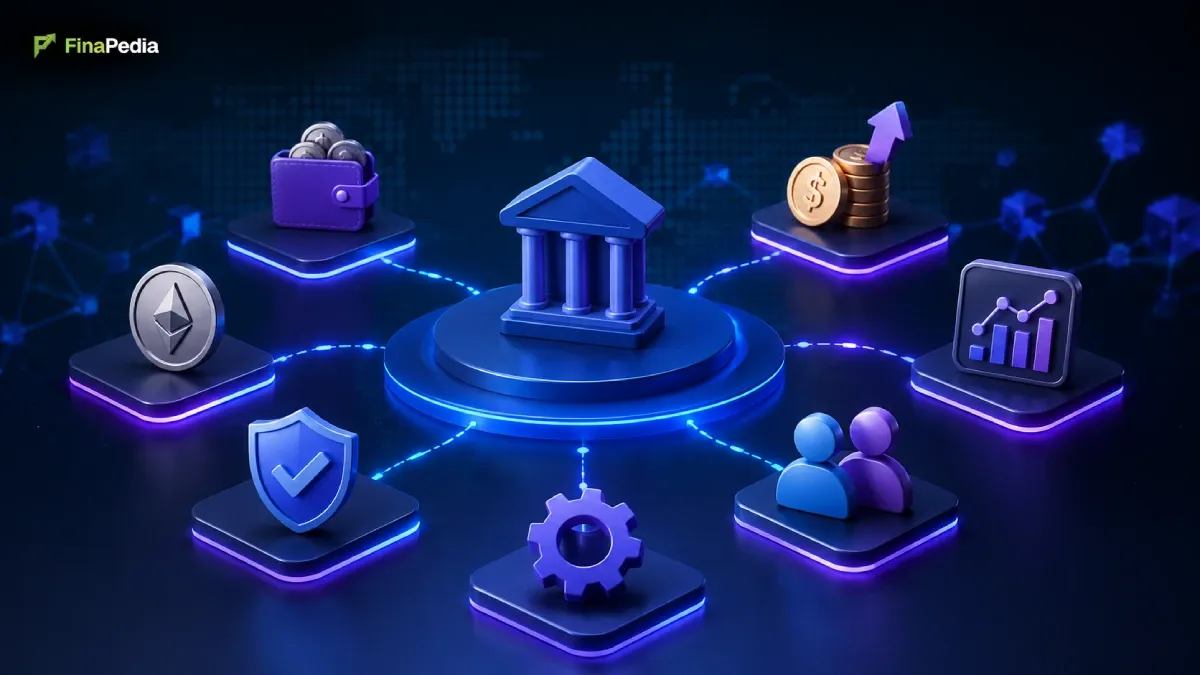
Decentralized finance, or DeFi, is a collection of blockchain-based financial services that people can use through crypto wallets. Instead of asking a bank, broker or centralized exchange to process every action, users interact with programs called smart contracts to swap assets, lend, borrow, stake or provide liquidity.
A simple way to think about DeFi is financial software running on a public blockchain. The rules are written into code, transactions are recorded on-chain and users normally keep control of their wallets, but that does not make DeFi automatically safe, fully decentralized or free from intermediaries.
This guide explains how DeFi works, what people use it for and which risks beginners should understand before connecting a wallet.
Risk warning: DeFi products can expose users to smart-contract failures, scams, volatile assets, liquidation, stablecoin problems and irreversible transaction errors. This article is educational and does not constitute financial, investment, legal or tax advice.
What does DeFi mean?
DeFi stands for decentralized finance. It is an umbrella term for financial applications built on blockchains, including decentralized exchanges, lending markets, stablecoins, derivatives and asset-management tools.
Traditional finance usually relies on companies to maintain accounts, approve transactions and settle trades. In DeFi, smart contracts perform many of those functions according to programmed rules. A smart contract can hold assets and transfer them when defined conditions are met.
“Decentralized” does not always mean that nobody is in control. A protocol may still depend on a development team, token holders, administrators, price-data providers or a centralized website. The Bank for International Settlements has described this as a “decentralisation illusion,” because governance and other structural features can concentrate power.
If terms such as blockchain, smart contract and stablecoin are unfamiliar, Finapedia’s crypto glossary of core terms provides a useful foundation.
How does DeFi work?
Most DeFi activity involves four basic layers:
Blockchain: The network that processes transactions and records account balances.
Crypto assets: The coins and tokens users trade, supply as collateral or deposit into protocols.
Smart contracts: Programs that apply a protocol’s rules automatically.
User applications: Websites or wallet interfaces that make smart contracts easier to use.
A user typically connects a compatible crypto wallet to a DeFi application. The application then asks the user to sign wallet messages or approve transactions. Once submitted, the blockchain validates the transaction and the relevant smart contract carries out the requested action.
For example, a decentralized exchange can use smart contracts and liquidity pools to let one user swap ETH for a stablecoin without sending the assets to a conventional exchange account. The wallet remains the user’s access point, while the protocol’s code handles the swap.
The user will normally pay a network fee, often called a gas fee, to process an on-chain transaction. Fees and confirmation times vary by blockchain and network demand, and approving a token does not necessarily execute the intended swap, it may only give a smart contract permission to access that token.
What can you do with DeFi?
DeFi attempts to provide services similar to those found in traditional finance, but through blockchain applications. Common activities include trading, lending, borrowing and earning protocol incentives.
Swap tokens
A decentralized exchange, or DEX, allows users to trade compatible tokens from a wallet. Many DEXs rely on liquidity pools rather than a traditional company-operated order book.
DEX trading can offer direct wallet access and on-chain transparency, but users must manage network selection, token addresses, transaction fees and slippage. Finapedia’s CEX vs DEX guide explains how decentralized trading differs from using a centralized exchange.
Lend and borrow
DeFi lending protocols allow users to supply crypto assets to a pool and potentially receive variable rewards. Borrowers usually deposit other crypto assets as collateral before taking a loan.
Because crypto collateral is volatile, a borrower’s position can be liquidated if its value falls below the protocol’s required level. This means a loan can be automatically closed and collateral sold without the type of personal negotiation that might occur with a traditional lender.
Provide liquidity
Users can deposit token pairs into a liquidity pool that supports trades on a decentralized exchange. In return, liquidity providers may receive a share of trading fees or additional token incentives.
The advertised yield is not a guaranteed return. Providers can face token-price losses, smart-contract risk and impermanent loss, which occurs when the value of deposited assets changes relative to simply holding them.
Stake and use liquid staking
Staking helps secure proof-of-stake blockchains, while liquid-staking services issue a token representing a staked position. That token may then be used in other DeFi applications, adding flexibility as well as another layer of protocol and smart-contract risk.
Staking is related to DeFi but is not identical to it. Finapedia’s guide to what staking is and how it works explains validators, rewards, unstaking and slashing in more detail.
Use stablecoins
Stablecoins are crypto tokens designed to track an external asset, commonly a fiat currency. They are widely used for trading, collateral and transferring value between DeFi protocols.
A stablecoin can still lose its target price or experience issuer, reserve, liquidity or smart-contract problems. Regulators and researchers have identified stablecoin stress as a potential channel through which risk can spread across interconnected DeFi markets.
DeFi vs traditional finance
The practical difference is not simply “banks versus no banks.” DeFi changes who controls access, who holds assets, how transactions settle and what happens when something goes wrong.
Area | Traditional finance | DeFi |
|---|---|---|
Access | Usually requires an approved account and may depend on location | Typically accessed with a compatible wallet and network funds |
Execution | Companies and financial institutions process transactions | Smart contracts execute programmed rules |
Custody | A bank, broker or custodian usually holds assets | Users often control wallet keys, although some services retain centralized elements |
Availability | Services follow institutional and market schedules | Blockchain applications can generally be used at any time, subject to network and interface availability |
Transparency | Records and internal systems may not be public | Public-chain transactions and contract code can be inspectable, although understanding them requires expertise |
Error handling | Institutions may reverse or investigate some errors | Confirmed blockchain transactions are generally difficult or impossible to reverse |
Protection | May include regulated complaint and compensation systems | Legal responsibility and user recourse may be unclear or limited |
DeFi can reduce reliance on parts of the traditional intermediation chain and may improve competition or efficiency in some uses. However, technical complexity, volatile collateral and uncertain accountability introduce risks that a simple “remove the middleman” description can hide.
DeFi vs centralized exchanges
A centralized crypto exchange creates an account for the user and generally takes custody of deposited assets. It maintains internal records and processes withdrawals according to its policies.
A DeFi application usually asks the user to connect a wallet and authorize a smart contract. This can remove exchange-custody risk, but it transfers more responsibility to the user. Losing a recovery phrase, approving a malicious contract or using the wrong network can result in permanent loss.
Question | Centralized exchange | DeFi application |
|---|---|---|
Who holds the assets? | Usually the exchange while funds remain deposited | Usually the user’s wallet or a protocol smart contract |
Is an account required? | Usually yes, often with identity verification | Often no conventional account, although interfaces may apply restrictions |
Who handles support? | A company support team | Support and recourse vary and may be limited |
Main risk | Custody, solvency and account-access risk | Smart-contract, wallet, oracle and transaction risk |
Best suited to | Simpler fiat access and conventional support | Users comfortable with wallets and on-chain transactions |
Neither model is automatically safer. The relevant question is which risks the user understands and can manage.
A simple DeFi example
Imagine that Alex has ETH and wants to borrow a stablecoin without selling the ETH.
Alex connects a wallet to a lending protocol.
Alex deposits ETH into a smart contract as collateral.
The protocol allows Alex to borrow a smaller value of stablecoins.
Interest accumulates according to the protocol’s variable rate.
Alex repays the loan and withdraws the collateral.
If ETH falls too far before the loan is repaid, the position may cross the protocol’s liquidation threshold. The smart contract can then sell some or all of the collateral to cover the debt. This automatic enforcement makes DeFi lending possible without a traditional credit check, but it also exposes borrowers to sudden liquidation when markets are volatile.
Main DeFi benefits
DeFi offers several potential advantages when the protocol, assets and user practices are sound:
Open access: Many services can be accessed through a compatible wallet rather than a traditional account application.
Self-custody: Users can often retain control of their wallet credentials instead of depositing everything with a centralized company.
Transparency: Transactions and smart-contract activity on public blockchains can be inspected.
Programmability: Developers can combine protocols to build new products and automated strategies.
Continuous markets: Many applications operate around the clock, subject to blockchain and interface availability.
These are potential benefits, not guarantees. An open protocol can still have an unsafe contract, concentrated governance, misleading incentives or an unreliable interface.
Main DeFi risks
DeFi is not simply a higher-yield version of a savings account. It combines financial, software and operational risks, often with limited options for recovering funds.
Smart-contract vulnerabilities
A programming error or design flaw can allow attackers to drain a protocol. Even audited code is not guaranteed to be free of vulnerabilities, and interconnected protocols can spread the impact of one failure.
Scams and malicious approvals
Fake websites, imitation tokens and malicious wallet requests can trick users into granting access to their assets. A transaction can be valid on the blockchain and still be financially harmful.
Market and liquidation risk
Crypto collateral can lose value quickly. Lending protocols may automatically liquidate positions when collateral ratios fall, and leverage can intensify losses during volatile markets.
Stablecoin and liquidity risk
A stablecoin may lose its peg, while a liquidity pool may become too shallow to support a trade at the expected price. Liquidity stress can spread between protocols because DeFi applications frequently depend on shared assets and services.
Oracle and market-manipulation risk
Protocols rely on price feeds known as oracles. A faulty or manipulated oracle can trigger incorrect trades, borrowing limits or liquidations. The CFTC has also highlighted front-running, wash trading and oracle exploitation among DeFi market-integrity risks.
Governance and centralization risk
A small group may control administrator keys, token voting power or major infrastructure. This can allow unexpected rule changes, emergency interventions or abuse, even when a product markets itself as decentralized.
User-error and custody risk
Blockchain transfers are generally irreversible. Sending funds to the wrong address, losing a recovery phrase or signing an unsafe transaction can cause permanent loss.
Before using DeFi, beginners should understand how wallet custody works. Finapedia’s hot wallet vs cold wallet guide explains the trade-off between convenient access and offline storage.
How to use DeFi more safely
No checklist can remove every risk, but a conservative process can reduce avoidable mistakes:
Learn the wallet first. Understand recovery phrases, transaction signing, network fees and token approvals before depositing meaningful funds.
Verify the application. Use the project’s confirmed domain and avoid links sent through unsolicited messages or search advertisements.
Research the protocol. Check its documentation, history, governance, audits and known incidents. An audit reduces uncertainty but does not guarantee safety.
Start with a small amount. Make a test transaction and confirm how deposits, withdrawals and approvals work.
Read every wallet request. Confirm the network, token, amount, permission and destination before signing.
Avoid unknown tokens and unrealistic yields. Very high rewards commonly signal inflation, low liquidity or additional risk rather than free income.
Limit approvals. Avoid unlimited token permissions when a smaller allowance is practical, and periodically revoke permissions that are no longer needed.
Keep reserve funds separate. Do not expose all holdings to one wallet, protocol, blockchain, bridge or stablecoin.
Understand exit conditions. Check lock-ups, withdrawal queues, collateral ratios, liquidation thresholds, slippage and available liquidity.
Plan for failure. Assume that a smart contract, website, token or wallet could fail, and size each position accordingly.
Is DeFi suitable for beginners?
DeFi can be used by beginners, but it is not a beginner-safe environment by default. The lack of conventional account recovery, irreversible transactions and technical complexity means that users must take on responsibilities normally handled by an institution.
A cautious beginner should first learn how wallets and networks work, practice with a very small amount and avoid borrowing, leverage, bridges and unfamiliar yield strategies. Basic swaps on established protocols may be easier to understand than multi-protocol strategies, but even a simple swap carries contract, token and user-error risks.
The goal should not be to find the highest advertised yield. It should be to understand exactly where the assets go, what can cause a loss and how to exit the position.
Frequently asked questions
Is DeFi the same as crypto?
No. Crypto is the broader category of blockchain-based assets and networks. DeFi refers specifically to financial applications and services built using crypto assets, blockchains and smart contracts.
Do you need a bank account to use DeFi?
A bank account is generally not required to interact with a DeFi smart contract once a user has a compatible wallet and crypto for the transaction and network fee. However, many people use a bank or centralized exchange to obtain crypto initially, and access restrictions can apply at websites, payment providers or local regulatory gateways.
Can you make money with DeFi?
DeFi may provide trading gains, lending returns, liquidity fees or token incentives, but none is guaranteed. Token prices can fall, yields can change, and smart-contract, liquidation, liquidity or stablecoin failures can outweigh any rewards.
Is DeFi safe?
DeFi is not risk-free. Regulators and researchers identify software vulnerabilities, fraud, manipulation, custody problems, volatile collateral, liquidity stress and unclear accountability among its major risks. Safety depends on the protocol, assets, wallet practices and how much risk the user takes.
What is a DeFi wallet?
A “DeFi wallet” usually means a self-custody crypto wallet that can connect to decentralized applications. The wallet stores the credentials used to authorize transactions; it does not guarantee that the connected application or smart contract is safe.
What is a DApp?
A decentralized application, or DApp, is an application that uses blockchain smart contracts for some or all of its core functions. The website is usually an interface, while the smart contracts process on-chain actions.
What is a DeFi protocol?
A DeFi protocol is a set of smart contracts and rules that provides a financial function, such as swapping, lending or borrowing. Different websites and wallets may connect to the same underlying protocol.
Can a DeFi transaction be reversed?
A confirmed blockchain transaction is generally difficult or impossible to reverse. A protocol may include special controls or recovery procedures, but users should assume that mistaken transfers and malicious approvals might not be recoverable.
Is DeFi completely decentralized?
Not always. A protocol may depend on core developers, governance-token holders, administrator keys, centralized front ends or external price oracles. The degree of decentralization should be evaluated protocol by protocol rather than assumed from the “DeFi” label.
Related guides
What is staking and how does it work?
Crypto staking lets you earn rewards by helping secure proof‑of‑stake blockchains. Learn how staking works, different methods, and key risks beginners must understand.
What is spot trading vs futures (beginner’s guide)
New to crypto trading? Learn the difference between spot and futures, how they work, and which is safer for beginners before you touch leverage.

How to move crypto between exchanges safely
Learn how to move crypto between exchanges safely with step-by-step tips on networks, test transfers, fees, wallet checks and avoiding costly mistakes.