
What is spot trading vs futures (beginner’s guide)
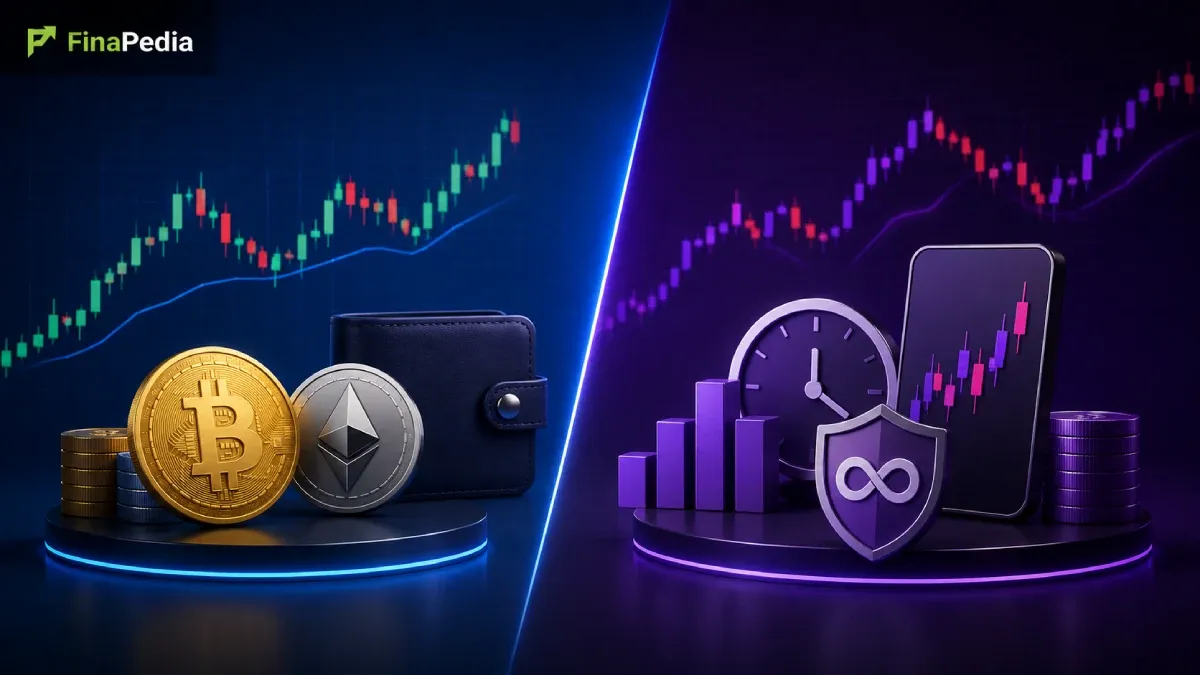
If you’ve just opened your first crypto exchange account, you’ve probably seen tabs for Spot and Futures and wondered what the difference is. Spot trading is the simplest way to buy and hold crypto, while futures trading lets you speculate on price moves (often with leverage) without necessarily owning the coin.
For beginners, understanding this difference is critical because futures can amplify both profits and losses, and the wrong product choice can wipe out an account very quickly. If you’re still choosing where to trade, it’s worth pairing this article with Finapedia’s How to choose a crypto exchange: beginner’s checklist and Crypto glossary: core terms explained so key terms stay clear.
What is spot trading?
Spot trading means buying or selling the actual asset for immediate delivery at the current market price.
In crypto:
You buy coins like Bitcoin or Ethereum directly at the spot price and actually own them.
There is no built‑in leverage by default; you are trading 1:1 with your own capital unless you explicitly borrow.
You can hold your coins as long as you want — there is no expiry date on a spot position.
Because you own the asset, you can withdraw it to a self‑custody wallet or another exchange whenever you like, and your main risk is that the price goes down. This simplicity is why most educational resources recommend that true beginners start with spot trading first.
What is futures trading?
Futures trading lets you trade contracts whose value tracks an underlying asset’s price, instead of buying the asset itself.
In crypto:
You post collateral (margin) and open a futures contract that follows the price of a coin like BTC or ETH.
You can go long (bet on price going up) or short (bet on price going down) using the same product.
Most crypto futures are perpetual contracts (“perps”) with no fixed expiry date, kept in line with spot via a funding rate paid between longs and shorts.
Futures include leverage, margin, funding, and liquidation mechanics, which means the product is more complex and riskier than simple spot trading. Many exchanges also offer very high maximum leverage, which can magnify both gains and losses dramatically.
For readers who want a deeper dive into how different futures platforms compare, Finapedia’s Binance vs Bybit for futures trading is a useful next step once the basics here feel clear.
Key differences between spot and futures
Here’s a simplified comparison table based on several beginner‑friendly guides:
Aspect | Spot trading | Futures trading |
|---|---|---|
What you hold | Actual coins/tokens you own. | A contract linked to the asset price. |
Leverage | None by default (1:1). | Commonly 2x–20x; some exchanges offer 100x+. |
Liquidation risk | No forced liquidation if unlevered. | Positions can be forcibly closed if margin is too low. |
Funding rate | Not applicable. | Applies to perpetuals; charged/paid every few hours. |
Direction | Mainly “buy low, sell high”. | Can go long or short. |
Time horizon | No expiry; you can hold indefinitely. | Perps have no expiry, but funding and margin constraints apply. |
Complexity | Lower — price, fees, custody. | Higher — margin, leverage, funding, liquidation. |
The core idea is simple:
Spot is ownership.
Futures is a leveraged bet on price direction.
Which is better for beginners?
Most reputable educational sources and trading blogs agree:
for most beginners, spot trading is the better starting lane.
Reasons include:
You actually own the asset, can withdraw it, and can hold through volatility without worrying about liquidation.
There is no built‑in leverage by default, so your losses are limited to what you invested rather than a leveraged multiple of that amount.
You don’t pay funding fees every few hours just to hold a position, so long‑term exposure is simpler and cheaper.
Many guides explicitly recommend trading spot only for at least several months before touching futures, so you can see how volatile crypto is without leverage first.
To build that foundation, it helps to understand exchanges and wallets properly. Finapedia’s Centralized vs decentralized exchanges (CEX vs DEX) and Hot wallet vs cold wallet explained are good companion guides while you stay in spot mode.
Why futures feel “faster” and why that’s dangerous
Futures attract many new traders because they make it possible to “do more with less capital”: you can control a large position with a small margin deposit. But leverage doesn’t just accelerate profits, it accelerates losses and the risk of liquidation:
At 10x leverage, a 10% move against you can wipe out your margin.
At 20x leverage, a 5% move can be enough; at 50x, even a 2% move can trigger liquidation.
Crypto markets routinely move 5–10% in a single day, which means high‑leverage positions can be liquidated within minutes.
On top of that:
Funding rates on perpetual contracts can quietly drain your profits if you hold positions for days in a hot market.
Emotional pressure rises with leverage, multiple risk‑management guides note that high leverage increases stress, over‑trading and revenge trading.
Some research‑driven pieces go as far as saying that over 90–95% of futures traders ultimately lose money, and that many blow up their first accounts in less than six months because of leverage misuse. That’s why futures are generally considered unsuitable for complete beginners.
When does using futures make sense?
Futures are not inherently “bad”; they’re just a different tool that fits specific use cases when you already understand spot, risk and position sizing.
Examples include:
Hedging: Short futures to temporarily offset risk on a spot position during a risky event.
Short‑term speculation: Taking directional bets around clear setups with pre‑defined stop‑loss levels and small, controlled risk per trade.
Basis trades and more advanced strategies: Combining spot and futures in equal notional size to capture small price differences, which is only appropriate once you understand funding and execution risk.
Even in these cases, risk‑management guides recommend low leverage (2x–5x), small risk per trade (often 1–2% of capital), and strict stop‑loss discipline.
If you’re curious which platforms are commonly used for spot vs futures (Binance, Bybit, OKX, Kraken, etc.), Finapedia’s comparisons like Binance vs Bybit for futures trading are a better place to dive into platform‑specific details once your conceptual basics are solid.
How to decide: spot vs futures for your next trade
When you’re about to click “Open position”, run through these questions:
Is this a long‑term investment or a short‑term trade?
Long‑term → spot is usually better (buy and hold).
Short‑term, event‑driven → futures can be appropriate if you understand the risk.
Do I really need leverage for this idea?
If not, you can probably just use spot and size the position appropriately.
Can I clearly define my maximum loss before entering?
If you can’t, futures leverage is likely too dangerous right now.
Have I traded spot consistently first?
Most beginner guides suggest several months of spot trading before touching futures.
This is also a good moment to ensure you’re using a reputable platform in the first place. Finapedia’s How to spot a safe crypto exchange explains how to evaluate security, regulation and proof‑of‑reserves before you put serious capital at risk on any market spot or futures.
Important disclaimer
This article is for educational purposes only and does not constitute financial, investment, tax, or legal advice. Crypto assets are highly volatile, and both hot and cold wallet solutions can fail if misconfigured or misused; always do your own research and consult qualified professionals before making major financial decisions.
Frequently asked questions
Is spot trading safer than futures trading?
For most beginners, yes. Spot trading involves owning the actual asset with no built‑in leverage, so your maximum loss is limited to what you invested and there is no forced liquidation on unlevered positions. Futures trading adds leverage, funding costs and liquidation risk, which can wipe out your margin from relatively small price moves.
Can I lose more than I invest with futures?
You can lose all of your futures margin much faster than you might expect; in extreme conditions or with certain products, losses beyond margin are theoretically possible, though exchanges design risk systems to reduce that risk. At high leverage, even a 2–5% adverse move can be enough to liquidate a position and wipe out your initial margin.
Do I need futures to short crypto?
Not necessarily, but futures are the most common simple way to short crypto for many traders because they let you profit from falling prices using the same contract structure. However, shorting with futures carries the same leverage and liquidation risks as long positions, so it’s not recommended for complete beginners.
Can I hold futures positions long term?
Perpetual futures have no expiry, so you can technically hold them indefinitely, but funding rates and volatility make long‑term holding risky and potentially expensive. Spot positions are better suited for long‑term exposure because there is no funding cost and no liquidation risk on unlevered holdings.
When should I move from spot to futures?
Risk‑education resources suggest only considering futures after you have: - Traded spot consistently through different market conditions. - Learned basic risk management (position sizing, stop‑losses, maximum loss per trade). - Developed a written plan for why you need futures (hedging, specific strategies), not just to “amplify returns”. - Even then, they recommend starting with low leverage (2x–5x) and small position sizes, treating early futures trades as training, not as a shortcut to fast profits.
Are spot and futures taxed differently?
In many jurisdictions, spot trades are taxed under capital gains rules, whereas futures and derivatives may be treated as ordinary income or subject to different reporting rules. The exact treatment is highly country‑specific, so you should consult a qualified tax professional in your region rather than relying on generic guidance.
Related guides

What Is DeFi? A Plain-English Guide
DeFi uses blockchain apps to offer trading, lending, borrowing and other financial services. Learn how it works, what you can do and the risks.
What is staking and how does it work?
Crypto staking lets you earn rewards by helping secure proof‑of‑stake blockchains. Learn how staking works, different methods, and key risks beginners must understand.

How to move crypto between exchanges safely
Learn how to move crypto between exchanges safely with step-by-step tips on networks, test transfers, fees, wallet checks and avoiding costly mistakes.